
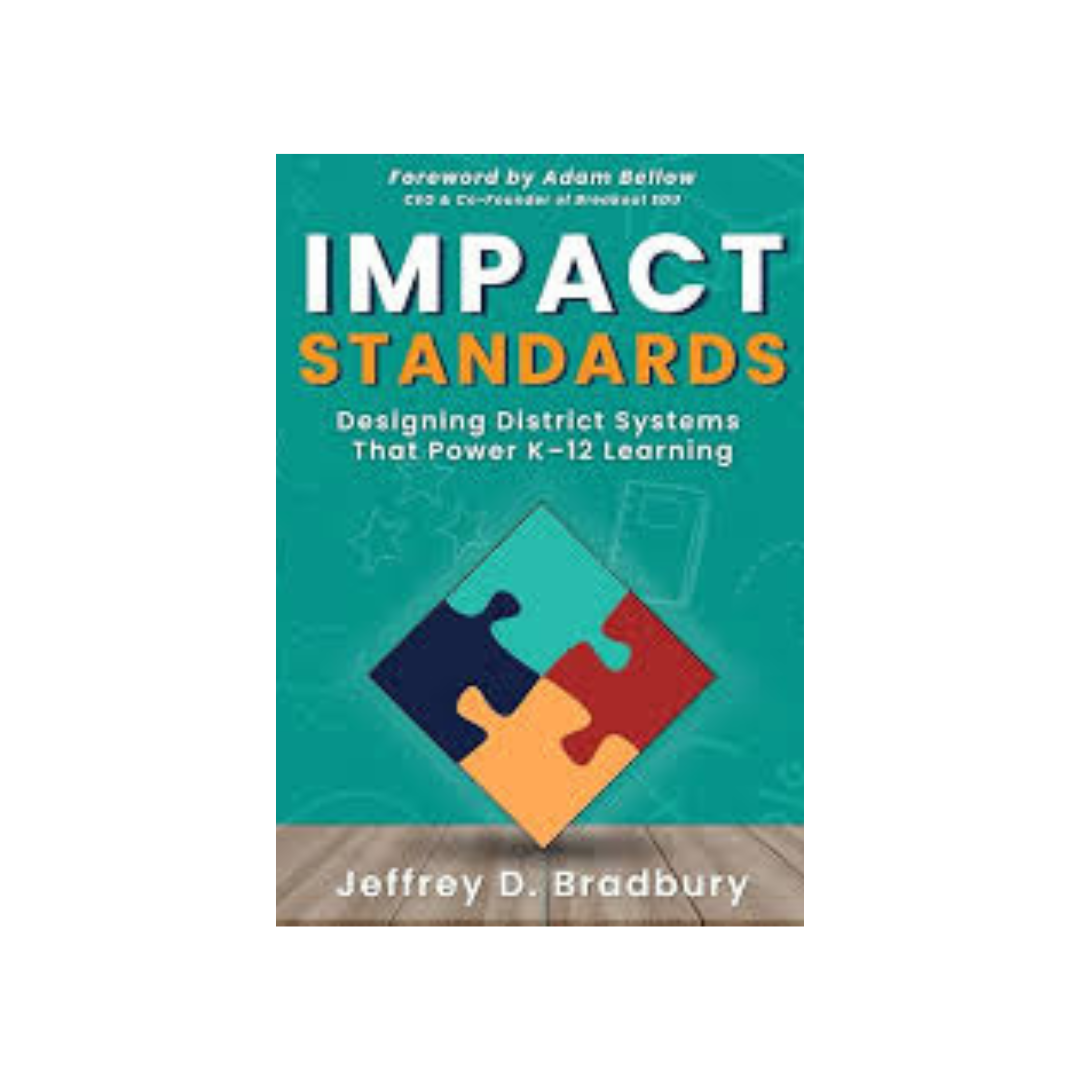
Impact Standards surveys the journey Jeff Bradbury took from music teacher, to podcasting with educators, to instructional tech coach, to EdTech champion. It encompasses what he learned along the way, the systems and processes he built to help manage it all, to help pave the way in adopting and implementing similar systems and processes in the reader’s schools and districts. While I do not agree with everything he lays out, it is a helpful perspective of a top-down approach to making the cogwheels of education run. My predominant contention with the approach is that it revolves around standards and consistency, which echoes the factory-model approach to education and tries to conform educators into a universal package. The beauty of education is the diverse kaleidoscope of ideas and approaches that students encounter as they learn and develop. We need to shift away from conformity and adopt flexible, agile processes that leave plenty of room for curiosity and creativity to hold sway in the learning spaces. As I reflect on this book, I’ll provide questions to discuss with your school district, inspired by questions and ideas from the book.
In the foreword, Adam Bellow issues a statement that requires some unpacking, summarized as digital learning is equated with technology and access is often conflated with integration, or novelty with innovation. Let’s start with the first bit – access and integration are not the same thing. You can have a 1:1 device program, but that doesn’t mean technology and digital learning are actually integrated into your learning space (I prefer learning space to classroom as a term, it encompasses my hopes and vision for education much more than the factory model term of classroom). Integration refers to the tools of learning being intentionally part of the learning process, from the get-go. Too often, a lesson is designed, and then it is realized that technology *should* be in there somewhere, so it is added in post-mortem. While post-mortem may sound morbid, adding technology in this way effectively puts learning to death in a slow squeeze, so it is an appropriate phrase. Now the second bit: novelty and innovation. Novelty can be something new, and because it is new, and different, it feels like innovation in the moment. But innovation should be more than new. Innovation refers to changing something in a net positive way. Within education, I use innovation to refer to ideas and tools and processes that change learning in meaningful ways to ensure students can do something they couldn’t do before. In this sense, innovation and technology go hand-in-hand with digital learning, because technology is a tool that enable us to do things we either couldn’t do before, or can do better, faster, smarter, etc. Technology should be the modality of innovation. But it cannot be the derivation.
Discussion questions for your team and school: How do you define technology integration, innovation, and digital learning? Does everyone agree on the terminology?
Diving into the meat of digital learning, Bradbury proposes a guiding question: “What do you want standards-based instruction to look like when you walk into a classroom?” I love that he starts with a question, but I’m not certain this is the right question, at least not for our district. While we are a standards-based instruction school, as I reflect on this question I have two follow-up questions. First, the question is phrased in a way that infers that instruction should ‘look a certain way’ when you enter a classroom. But should it all look the same? Should standards-based instruction be encapsulated into neat little boxes that can be objectively evaluated and aligned with district vision? Neat little boxes certainly make it easier for coaches and admin to do their jobs, but do the neat little boxes actually serve students the best? Now to my second question, how big is the sandbox for educators to play in with standards-based instruction? How much levity and freedom is there so that when you walk into a classroom you can still identify the standards-based instruction, even though it takes a different form than what is happening in the classroom next door, or across the hall, or across the school? These are the questions that drive me and my curiosity.
Discussion questions for your team and school: How uniform should standards-based instruction look? Do you want it to all look the same when you step into a classroom? How big is the sandbox for teachers to play in, as long as they still address the standards?
The roadmap for culture-shift for district learning comes down to these building blocks (buckle-up, this might get lengthy):
- Identifying the pieces of the puzzle (what one of the admin and I colloquially call ‘eating the elephant’)
- Developing a shared vision & goals (starting with a district level vision, then using it to inform educational technology vision, from there trickling down to the educators…)
- Prioritizing professional learning in & out of district (what I refer to as a ‘culture of learning’)
- Create a standards-based evaluation method (my main point of contention, I think this is the wrong direction)
- Supply constant support for all (agree that this isn’t just students, it includes teachers and especially the wider community)
- Protecting students and digital safety (sadly where most of my time is spent, it comes down to equipping students with the skills, otherwise it will always be a losing battle)
One suggestion for supporting students and the community is implementing “a multi-layered digital citizenship curriculum integrated into core subjects.” Instead of splitting out digital literacy and 21st century citizenship into a specific technology course, these skills should be taught within every course. While I agree with Bradbury’s sentiment here, I think it needs to be pushed further, that is to say ALL teachers are responsible for raising up 21st Century Citizens! That is actually their primary aim, the standards are simply a vehicle for conveying the skills needed to thrive as a 21st century citizen.
In terms of creating a road-map from the district level, it should start with a single focus question, namely, what is the problem we are trying to solve? From there you can work backwards to solve the problem, in step-wise fashion. Once the overall district level problem is identified and vision cemented, an educational technology plan can be developed to address that vision and make strides towards solving the problem in conjunction with other initiatives. I really REALLY like this quote by Bradbury, I can’t say it better: “The Educational Technology Plan shows not what but how technology will be used in a district. It is a roadmap for how to use educational technology and best practices in teaching through digital learning standards and for how staff members will be trained in it.” When I first started at my school, we had an Educational Technology Plan that did exactly this. It outlined HOW technology will be used in the district, what the frameworks were for teaching with technology in all areas, and how educators would be trained to use the tools. A plan like this helps guide technology use, guide teachers, guide digital literacy, and approach training staff members.
Back to creating the plan, where to start? It is a daunting task. Bradbury simplifies the process by condensing it down to asking an essential question (gotta love that we are back to asking good questions). By an essential question, he really means “what is the thing the plan hopes to answer?” My thoughts went into a flurry as I jotted down some quick questions in hopes of formulating a (decent) starting point:
- How can we use technology to point to Jesus? (meh, presupposes technology use, try again)
- How does our use of technology point others to Jesus? (better, but still falls short, focuses too much on technology still)
- How can we transform learning with technology? (now we are getting somewhere, the focus shifted to learning, with technology as a vehicle)
- How do we foster life-long learners equipped to build Christ’s Kingdom? (THIS. Our true goal of educational technology is about equipping students to continue learning in order to be effective builders of Christ’s Kingdom. This aligns with our ESOs and mission and values, and is the sort of question that can drive change).
This question echoes how Bradbury approaches digital learning, “In the world of digital learning, it is never about the tool. It is always about the skill and/or learning outcomes for our students.” Even though educational technology relates to *shocker* technology use in a school, it really is about skills and process, not the tools themselves. This is why educational technology should be on the forefront of setting vision and tone for the whole school. The fundamentals of educational technology deal with mindsets and skills, so all the tools and training on the tools need to work together to foster a culture of learning those mindsets and skills cohesively, but no one outside of the educational technology department quite grasps the nuances and ways these factors intersect.
Discussion questions for your team and school: What are the pieces of the puzzle (what composes the elephant)? What is the overarching vision for the district? What is the Educational Technology vision that supports that vision and who is responsible for creating the plan? What should the evaluation method look like for staff (standards-based or personalized/differentiated?) How can we take steps to support the community with learning? What is your perspective on digital literacy and 21st century skills? Should these be taught separately or cohesively within all subjects? Is only a single teacher responsible for raising up 21st century citizens or are all staff involved in the process? What is the essential problem we are trying to address? What is the essential question driving our work and alignment? Are we in agreement on the essential question or do we have work to do before we can even begin to dream about next steps?
A bulk of the book focuses on PD and training for teachers, from planning it to actually implementing it in a way that benefits all involved. Bradbury writes that a needs assessment is a great place to start. It identifies where the gaps are, and what needs to be addressed, so you can maximize your time and solve problems instead of creating new ones. On the surface, I like the idea of a needs-assessment, it is probably what I would have come up with too. It makes logical sense, you can be assured that you are taking teacher needs into account when designing and offering PD for their benefit. But I’m not sure how effective a needs-assessment would actually be for our district, because needs fluctuate and change, and it takes time to respond to and implement action based on the assessment. I lean towards a much more flexible approach, of equipping teachers with the mindset and skills to learn on their own, which can be adapted to any unforeseeable situation that WILL come up. Further, a needs-assessment also presupposes that training is the answer, which is not always the case. If your immediate reaction to survey results is “how will we train teachers on these gaps” then you are starting in the wrong place. Do the gaps actually exist, or do they only exist in the minds of the educator? Are the gaps overcome by training or are there other methods that will solve the problem? See what I mean? A culture of learning is not just professional development, it is a deeper mindset. If you are stuck in a revolving wheel of needs-assessment and continual PD, take a step back and approach the problem from another angle. There needs to be other ways to empower educators.
Next, Bradbury heavily emphasized ensuring that when you do a needs-assessment, make sure it has an admin’s backing, and that they are present while it is distributed. I’m going to stop right there. If people only listen to you because the admin is what gives you credibility, then you have already lost. If people in your school only do things because they feel like an admin is forcing them to do them, then there is a much deeper culture issue that needs to be addressed first, before coaching and PD can even happen. This refrain appears again and again through the book, that the admin need to be on your side, enforcing things. While I agree everyone needs to be on the same page, and the admin should support your initiatives (they are ultimately responsible for outcomes), I don’t believe that everything should be a top-down approach. I think that building a culture of learning comes from a grass-roots mentality, from bottom-up. That’s the whole point of culture-shift. You need to get teachers to do the things and take ownership of their learning because they want to, NOT because someone told them to. Until you resolve that tension, everything will be an uphill battle, and I’m not sure it is even worth fighting it.
Another point I disagree with are the three things every PD session needs: a reason for being, a call to action, and a follow-up action that leads to classroom instruction. I get it, you want to design meaningful PD that checks boxes and that you can track with data to say what the impact was at the end of the year. But learning doesn’t work this way. Real, deep learning that changes people takes time. It sometimes takes years. And it doesn’t always show up in a way that you can track with data. I am heavily invested in my own learning, I attend dozens of virtual webinars and workshops every year, but I don’t always have a clear sense of how to implement that I’m learning. But here is the thing. Over the past two years I adopted a growth mindset and dived into learning, and now I’m reaching a point where ideas I read two years ago are intersecting with other ideas and things are starting to click. The mountain of knowledge is accumulating and growing, my perspective is widening while also being sharpened. This is what actual deep learning looks like, but it only happened because I was willing to invest in a wide array of professional learning experiences. Disparate ideas and concepts intersect in fascinating ways, but we don’t know how/if they will when we are doing the PD itself. I just open myself up to new ideas. So PD doesn’t need to have these three things, learning can just be learning because it makes us better human beings, and isn’t that the whole point?
Let’s talk about EdTech Menus now. The “fundamental idea is that the Coach or Digital Learning Department has carefully analyzed an application or concept, determined the most effective teaching method, and created a standardized approach.” I think the basic concept of a “menu” of learning is appropriate, and I plan on creating a type of menu that lists out all the PD sessions I have prepared for easy reference for myself and admin (possibly viewable by educators as well…). But where I struggle is the assertion that there is a “most effective teaching method” and that there should be a “standardized approach” to PD. Now when PD is focused on teaching a brand new tool, it probably should be standardized, and there may be a most effective way to do this. But once you go past the fundamentals of a tool, I think teaching the tool should become very personalized, not standardized. The basic features need to be imparted to all, but the ways in which the tool is adapted to the classroom and implemented should be differentiated. There is no way to create a menu for this, as it would create too many varieties (Heinz 57 anyone?).
My other objection is that the idea of a menu focuses too much on the tool itself, not the application. Maybe other coaches are leaving the application up to the teacher, but I view my role as an important cog in the wheel of aiding the teacher in applying when and how to use the tool. Anyone can go on YouTube and learn the fundamentals of a tech tool. Making PD about that is actually a waste of time, except for when you have teachers that refuse to learn for themselves (story of my life). The bulk of PD should focus on the instructional concepts and applications. For example, my PD session on AI is not really on AI, it is on the question, how do we differentiate our lessons and resources for different student abilities? Then I demonstrate how AI can be used to solve this problem, but I don’t focus on a single tool at all. It isn’t “Teaching with Diffit” or “Grading with Brisk.” It’s “Differentiating Instruction with AI” and I leave the tools up to the teachers. I do have a standardized approach to teaching the Viewboards, but that is partly because it is the standard kit available in every classroom. Even though it is standardized, I want to make a distinction here: standardized approach does not equate to standardized learning. Teachers will leave my Viewboard session having learned different things, and that is more than okay, it should be celebrated. This is why as much as possible I try to train people on tools in a 1:1 situation, so I can tailor the way they learn it to who they are, because the teachers do not all learn the same. Even when I do group PD, I’m shifting my approach away from a standardized approach to more like the code of pirates (guidelines) to adapt and pivot in the moment.
My last comments related to PD are on incentives. While I’ve looked at various incentive programs and contemplated incorporating them into our plan, I think the need for incentives actually points to a deeper issue. If the only way you can convince educators to learn is to give them gift cards or “an extra vacation day” then something is wrong with your school culture. Put another way, if you only way you can convince adults who are tasked with inspiring kids in a love of learning is with swag, then what does that say about how effective the learning and education actually is for the students? Educators should wake up everyday excited to learn something new. That is the energy that will transform the classroom, empower students, and revitalize learning spaces. If that energy is reliant on a coffee truck parked outside in the parking lot, then you have a culture problem, not a teachers don’t want to do PD problem.
Discussion questions for your team and school: How do you characterize our school’s relationship with PD? Is it healthy? Unhealthy? How personalized and differentiated versus standardized should our PD offerings be? How do we involve teachers in the process of taking ownership over their learning? Will a needs-assessment empower educators or contribute to the ongoing problem of mass-produced factory model learning for all? How can we foster a love of learning for the sake of learning without learning needing a call to action and incentives?
Shifting from teacher learning to student learning, we need to tackle the topic of Digital Learning. In Bradbury’s experience, “there must be a plan for getting all students the skills needed to be able to accomplish real world tasks once they graduate and are in the real world.” While I agree that students need to be equipped with the skills needed to thrive as adults once they graduate, I’m hung up on the phrasing of “tasks.” Tasks connotes specific functions of specific tools. The issue is that if we emphasize learning the tools to complete tasks, it becomes too tool-specific, and we all know how fast tools change. We need to be preparing students for a world that exists 5, 10, even 15 years from now. Most of the tools students will use in that timeframe haven’t even been developed yet, so why are we teaching them how to complete tasks? Instead focus on mindset and the 5Cs (I know formally there are 4Cs, but I include a 5th C): creativity, collaboration, communication, critical thinking, and curiosity. Empowered to complete tasks is short term, but empowered mindsets can approach new tools, problems, and ideas forever.
This quote sums it up well, but I would go a step further: “To create a successful program that guarantees student retention and success at the time of graduation, each faculty member must know and understand their role in the students’ development.” Where do I go a step further? Expanding it from “each faculty member” to “every single adult member of the school community.” This isn’t just a burden for teachers and admin. This is also the responsibility of janitors, kitchen staff, coaches, volunteers, parents, and board members. Simply put, it takes a village to raise a 21st Century Citizen equipped to build Christ’s Kingdom.
Discussion questions for your team and school: What is our scope and sequence from K-12 of digital learning skills? Are all our teachers cognizant of reinforcing the 5C’s in their learning spaces? Does every member of our community recognize the burden and responsibility of raising up 21st Century Citizens? If not, what steps can we take to affect culture change?
Now to the reason I bought the book in the first place: the section on Instructional Coaches (I’m not technically an instructional coach by title, but in practice I’m essentially fulfilling the role of an instructional tech coach). I’ll admit, this section was hard to get through. Not because I disagreed with many points, but because I did agree, and didn’t feel like my role was rolled out well. I started behind the start line because of how I was transitioned to my role, and it is frustrating because it could have been avoided. Now I have to play catch-up, when coaching itself is a tricky delicate position to be in the first place. To Bradbury’s point, a “district must have a clear definition and delineation of roles for its instructional coaches and how the position must be set up for success in the classroom and as a mentor, with administration as a building leader, and in community as an ambassador for innovation.” As far as I can tell, these pieces are not in place, and it puts me in an awkward situation at best.
What encouraged me in these chapters on coaching? The focus on the teacher and the goals of the teaching. Coaching isn’t about the coach, it is about the relationship formed between the coach and the teacher, and how that relationship drives innovation. The relationships are one reason I was put in this role. I built trust and credibility with the teachers in my time as tech support, and worked well with them. It was a natural conclusion to move me into a teacher-facing role, because without relationships, the coach cannot exist.
The traditional process of instructional coaches of working with coaching cycles with teachers does not apply to me at this time. It has been communicated to me that I am not allowed to go into classrooms or approach teachers with ideas unless the teacher asks first. This means that most of the time, I am not functioning as a coach. I am functioning as a support specialist on instructional technology, working on projects behind the scenes with admin. But Bradbury offers an alternative perspective to the traditional coaching model, what he calls “the unheard-of definition.” This version actually DOES apply to me, and in effect has been what I did in this first year in my role, “in this version, the coach works in partnership with building administrators to create a series of interactions. While these might appear to be simply ongoing professional development sessions, they are actually a carefully orchestrated set of coaching opportunities designed to support dynamic classroom interactions – all backed by data and verified through classroom observations by the administrator.” Okay not that last bit, we aren’t verifying my work through data or observations, but in general I have been intentionally building my “brand” as a coach and consciously shifting the narrative from “Job only knows technology” to “Job can help me learn and transform learning in my classroom.” To that effect, I define my role as “equipping teachers in raising up students as agents of renewal for Christ’s Kingdom.” Notice how there is no mention of technology in there? It isn’t about the technology AT ALL. It’s about innovating learning to develop better disciples to do Kingdom Work (remember what I said about the connection between innovation and technology at the beginning?).
Building my brand in this way is starting to pay dividends. I have teachers reaching out to me to discuss lessons and tools for their classrooms. I am intentional about equipping the few teachers I do work with, because I know all it takes is a few to create a ripple effect of change across the school. I make a positive impact on one teacher, then they are more prone to telling their fellow teachers the benefit of working with me, and/or taking what they learned from me and then collaborating with other teachers. I don’t care, it doesn’t need to come from me. I’m not gatekeeping knowledge, I’m expanding it. When teachers build off each other, it “transforms the school into a vibrant learning community where both teachers and students thrive on the energy of continuous improvement and shared discovery.” That is what it is all about. That is what I’m working towards. Again, technology isn’t the focus. It is just a tool, a vehicle for more possibilities, but the real aim is “continuous improvement and shared discovery.”
Discussion questions for your team and school: How are the instructional coaches and tech coaches defined, delineated, and presented to the school? Is there a cohesive structure and partnership between all coaches and the admin? What is the mindset of educators in working with the coaches?
My concluding thoughts reflect those in the closing pages of the book. Building culture is hard, because “culture is a living, breathing thing that is fragile at its core but rigid when provoked.” Shifting culture starts with a strategic plan, which I am encouraged by the fact that our new head of school has been developing and codifying. The strategic plan is built around his new four point vision. I did have the opportunity to present a fifth point to his vision, but as I articulated it to him it dawned on me that it isn’t a fifth distinct point, but actually the vehicle of how we get from where we are now, to where he is driving us. It is all dependent on a culture of learning. A devoted, vibrant culture of learning will transform our school into the four point vision he outlined. I am supported in developing this type of culture, grassroots style. I deeply believe that true culture change and infectious learning happens at the grassroots level. It happens person to person. It happens in the hallway passing by, it happens in the break room. It isn’t done in PLCs or in formal PD. This is why I’m not sold on standardized, data-driven approaches to PD and continuous learning. Real culture change cannot be measured by data. It happens by what Bradbury sums up as “get teachers asking questions that invite long conversations.” That is the answer to the essential questions. In turn, teachers will then invite students to ask the same sorts of questions that invite long conversations. Asking these sorts of questions, and having these sorts of conversations, is how you develop 21st century citizens, both teachers and students alike. People that critically think, are creative, eager to collaborate, use effective communication, and most importantly, are curious.
Discussion questions for your team and school: What would a culture of learning look like and how do we foster it from a grassroots level? What role does each person play in forward progress towards the head of school’s vision? Where does infectious learning naturally occur and how can it be coaxed to proliferate? Where does toxicity occur and how can it be persuaded to change?

Official Summary:
Are you ready to transform digital learning in your school or district from a scattered initiative into a strategic, sustainable culture shift? Impact Standards is the essential guide for educational leaders, instructional coaches, and classroom innovators looking to power K–12 learning through intentional design and impactful practices.
Drawing from decades of experience as a teacher, coach, district leader, and national voice in EdTech, Jeffrey D. Bradbury delivers a clear roadmap for building a future-ready learning environment. From creating a district-wide digital learning vision to designing curriculum aligned with the ISTE Standards and Future Ready Framework, this book equips you with actionable strategies to lead lasting change.